

The Batman Effect
It can also be Hulk, Antman, even Dora.

Reading time approx. 5 minutes
Good morning. Let's start this Tuesday together. Because, as always, "It is perfectly possible to be both rational and wrong."
Visual Nugget Summary
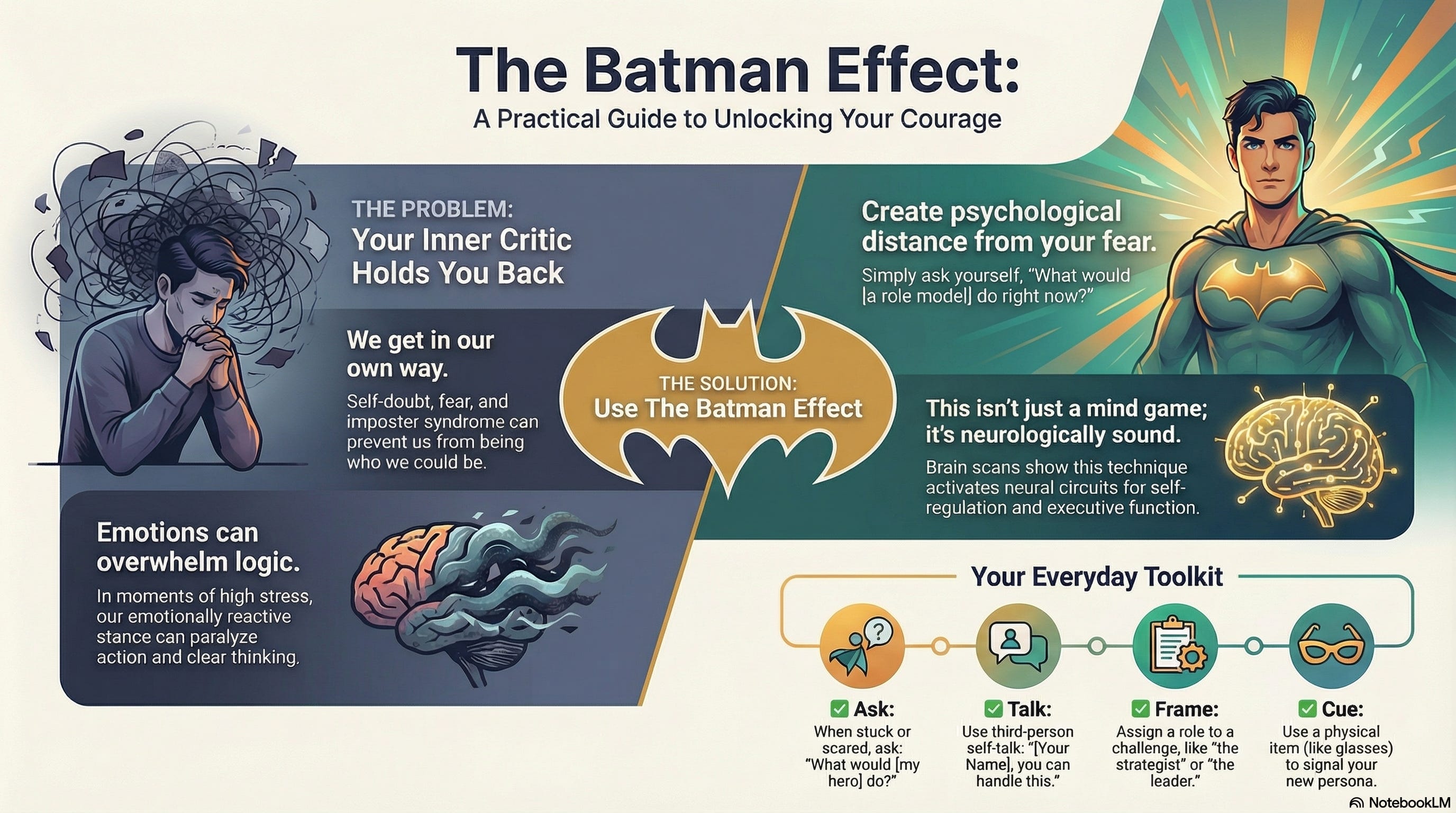
Who do you become when no one’s watching?
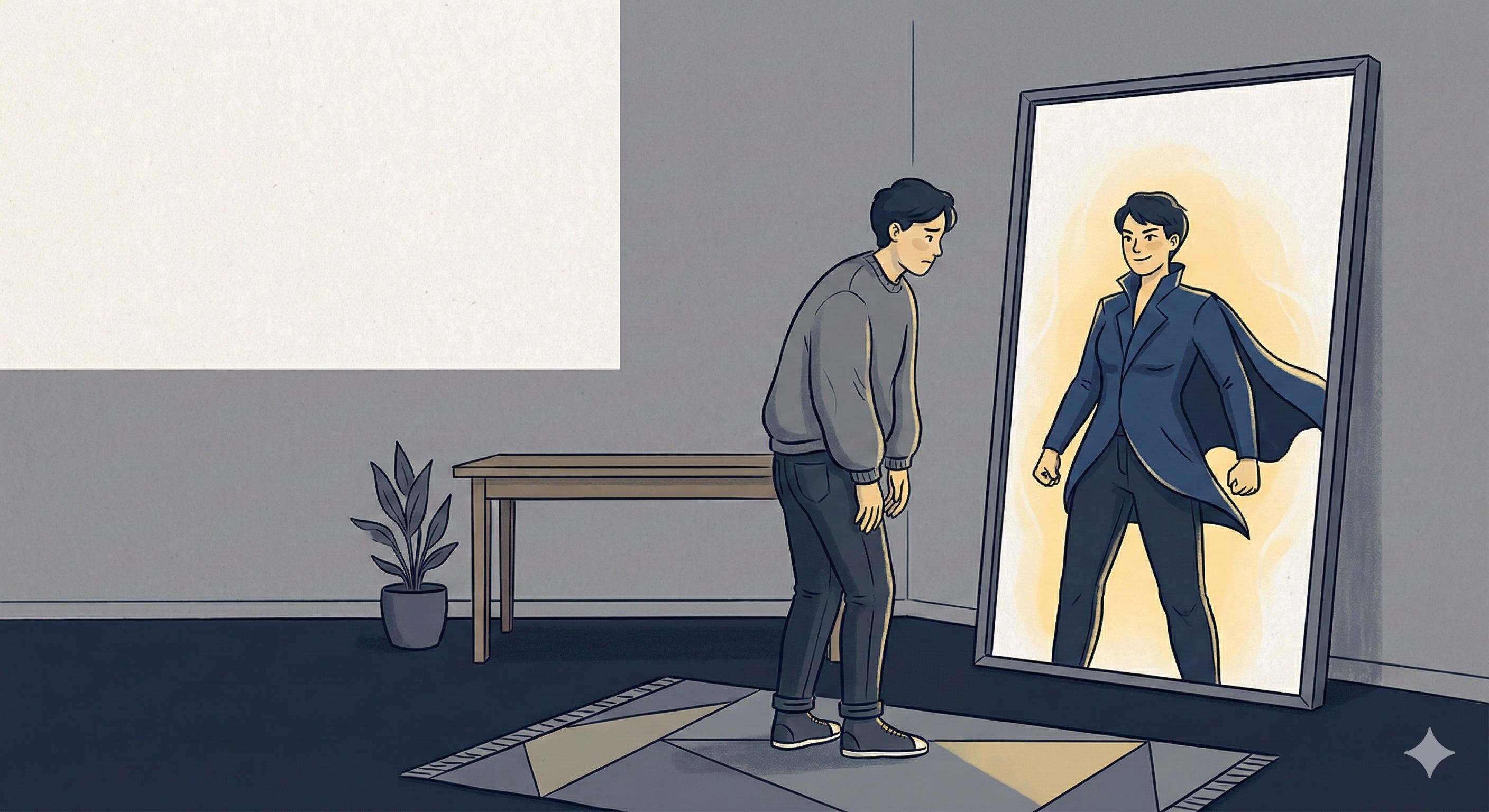
I was six years old, and terrified of the diving board. Every Tuesday was swim class, and every Tuesday I pretended to forget my swimsuit. My coach, Mrs. Ellen, saw right through me. One day, instead of coaxing me with yet another pep talk, she knelt beside me and asked:
“Hey. What would Batman do right now?”
Without thinking, I straightened my back. “Batman would jump,” I whispered.
“Then be Batman,” she said.
I walked to the edge. I was still scared, still shaking. But Batman wasn’t. Batman would jump, and so I did.
Years later, that moment stuck with me. Not just because I finally made the dive. But because I had found a way to trick my mind into courage. I wasn’t me, I was someone stronger. Braver. Someone I admired. It wouldn’t be the last time I’d need that trick.
Last year, during a big client pitch, imposter syndrome wrapped around me like a straightjacket. The voice in my head said I wasn’t ready, I’d mess up. Then, I remembered: What would Batman do? I stood up straighter. Slowed my breath. Talked like someone who belonged in the room. And by the time I finished my pitch, I realized: I had become that person. All over again.
How Does It Work? Science, Baby!
The Batman Effect is a cognitive distancing strategy. At its core, it’s about self-distancing: talking to yourself in the third person or imagining how someone you admire would behave in your place. This small shift in perspective helps reduce emotional overwhelm and increases self-control, especially in children, but surprisingly effective in adults too.
The term was coined by researchers including Rachel White and Ethan Kross, who observed that kids who pretended to be characters like Batman or Dora the Explorer were able to persist longer in boring or difficult tasks. Why? Because pretending to be someone else gave them psychological distance from their own frustration or boredom.
Self-distancing allows people to adopt a more rational, less emotionally reactive stance. It’s like swapping the shaky handheld camera of your own experience for a wide-angle lens. And in moments where emotions take over, like fear, anxiety, or doubt, that’s exactly what we need. It helps with everything from emotion regulation and decision-making to delaying gratification.
And here’s the kicker: this isn’t just mental fluff. Functional MRI studies show that self-distancing activates different neural circuits associated with regulation and executive function. In short: being Batman isn’t just cute, it’s neurologically sound.
📚 Quick side note: My book Drive Method is there. Interested in more deep insights about behavioral economics? Then this book is for you.
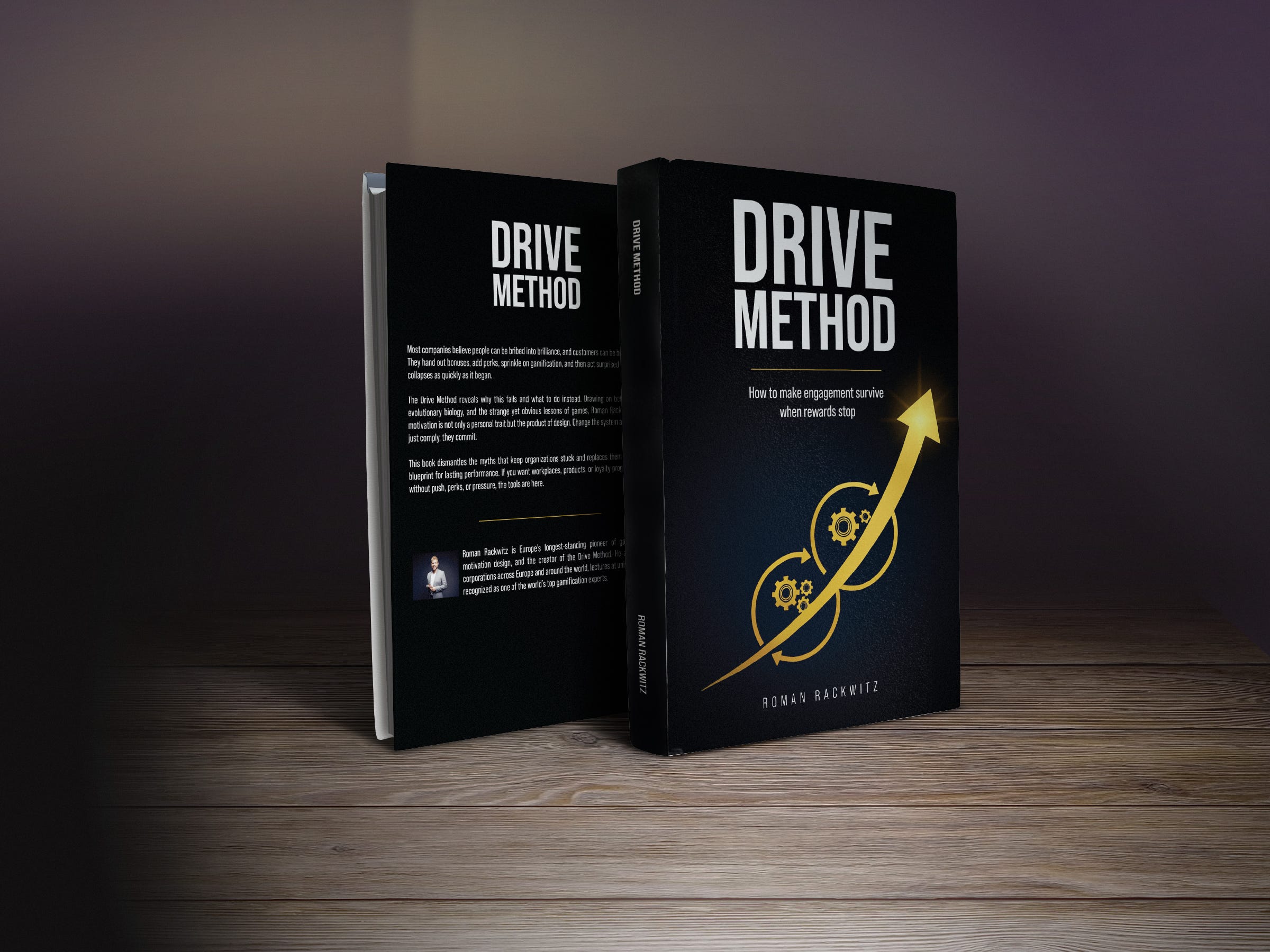
“What struck me most in this book is its focus on execution. This isn’t just another book about motivation theories, it’s a clear, actionable roadmap to designing lasting commitment. Roman draws from behavioral science, evolutionary biology, and game design to show that motivation isn’t a personal trait, it’s a product of design.
If you want to understand how to build systems where people don’t just comply but commit, this is a must-read. A brilliant work from one of Europe’s pioneers in gamification and motivation design!”Nicolas Babin (Business Strategist | LinkedIn Top Voice | Driving Innovation & Growth | Serial Entrepreneur (26 Startups) | Board Member | Author of The Talking Dog)
Why This Is Important?
Because sometimes, the person we are gets in the way of the person we could be.
Let me tell you about Mia. Mia was a rising star analyst at a consulting firm, but every time she had to speak up in meetings, her confidence evaporated. She knew her stuff, but the words caught in her throat. Her boss told her she needed to “speak with more authority,” but didn’t say how.
One day, frustrated after a long review, Mia tried something different. She remembered reading about the Batman Effect and decided: “What would Serena Williams do?” For some reason, Serena came to mind. Not because she was a consultant, but because of how she owned every room, every court, every moment. From then on, Mia prepared for meetings by putting on her “Serena hat.” She’d square her shoulders, speak clearly, and stop apologizing for having an opinion.
It didn’t change her personality, but it gave her a new access point to her courage. Within three months, her presence had changed completely. Not because she became someone else, but because she stopped being run by fear.
This is the quiet power of the Batman Effect: it’s not about delusion, it’s about perspective. It helps us step out of the mental trap of “I can’t” and into the mindset of “What would someone strong do?” That distance unlocks a door to action.
In times of stress, overwhelm, self-doubt - or when we need to stretch into new roles - we often forget that who we are in that moment isn’t the full story. The Batman Effect reminds us that we can borrow strength from identities we admire… until they start to feel like home.
And Now?
Try a mini-identity shift today. Facing a hard conversation? Ask: What would Brené Brown do? Leading a tricky meeting? Try channeling your inner Mandela. Struggling with focus? Be Marie Kondo for your to-do list.
Even better: give your alternate self a name and wardrobe cue. “CEO Alex” wears glasses. “Coach Jordan” uses a timer. These aren’t gimmicks, they’re cognitive scaffolding. Use role models as psychological tools, not just posters on the wall.
And if you catch yourself spiraling or procrastinating, zoom out. Third-person self-talk (“You’ve got this, [Your Name]”) actually works. Your inner superhero is closer than you think.
Bottom Line
The Batman Effect helps us perform better and handle stress by stepping into a more capable version of ourselves.
Checklist for everyday decisions:
Feeling stuck or scared? Ask: “What would [role model] do?”
Use third-person self-talk to create emotional distance: “[Your Name], you can handle this.”
Assign roles to challenges: be the “strategist,” the “protector,” the “visionary.”
Prepare with a mental (or physical) costume cue.
Don’t fake it: you’re not pretending, you’re accessing a real part of yourself.
Chief Behavioral Officer wanted
Where are management decisions made every day that are still based on people acting logically? Where can you be a Chief Behavioral Officer yourself this week?
See you next time.
If you would like to send us any tips or feedback, please email us at redaktion@cbo.news. Thank you very much.